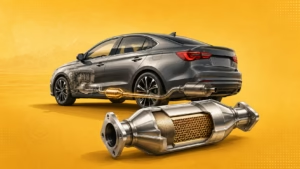
Introduction: A loss of power, a warning light, or a strong exhaust smell can make drivers suspect the converter. Yet these signs can also come from worn spark plugs, bad sensors, fuel faults, or exhaust leaks. Before paying for major repairs, use a clear test path. A proper check of the catalytic converter in a car should combine fault codes, live scan data, physical checks, and, when needed, workshop tests.
Key Takeaways
- A warning light alone does not prove converter failure.
- Read stored fault codes before replacing any parts.
- Check engine faults that may damage the converter.
- Low power can point to exhaust blockage.
- Backpressure testing gives useful evidence of a clog.
- Visual checks can reveal cracks, heat damage, or impact marks.
- Professional testing is safer when the exhaust is hot or access is poor.
What does a catalytic converter do?
It treats exhaust gases before they leave the tailpipe. Its internal structure supports chemical reactions that reduce harmful emissions when the engine and exhaust system work as designed.
The converter sits in the exhaust path. Inside, a coated core gives exhaust gas a wide surface to pass over. The coating may contain platinum, palladium, and rhodium. These metals can support the required chemical reactions without being consumed in the same way as fuel.
If you want a closer look at its structure, read this guide to how a catalytic converter works inside. Knowing the basic design makes later test results easier to understand.
A converter may lose chemical efficiency, become restricted, crack, or suffer damage to its inner core. These faults do not always produce the same symptoms. That is why one quick test rarely gives a firm answer.
What are the common signs of a bad converter?
Common signs include a check engine light, weak acceleration, poor high-speed power, failed emissions checks, unusual heat, rattling, or an odd exhaust smell. None of these signs confirms the fault by itself.
Does a check engine light mean the converter is bad?
No. The light means the vehicle has detected a fault, but the source may be elsewhere in the engine or emissions system.
A code linked with catalyst efficiency can raise suspicion. However, damaged wiring, an exhaust leak, a weak oxygen sensor, poor combustion, or a fuel control issue may affect the readings. Replacing the converter based on a code alone can waste time and money.
According to Georgia’s Clean Air Force, an onboard diagnostic system monitors emissions-related parts and can turn on the malfunction indicator light when it detects a problem. The stored data should guide the inspection, not act as a final verdict.
Can weak acceleration point to a clogged converter?
Yes. A restricted exhaust path can make it hard for the engine to move gases out, which may reduce power as engine speed rises.
The car may feel normal at idle but struggle during firm acceleration, uphill driving, or higher-speed travel. In a severe case, the engine may start and then stall. Similar symptoms can come from fuel delivery, ignition, air intake, or transmission faults, so further checks still matter.
Is rattling a sign of internal damage?
It can be. A loose or broken core may rattle inside the metal shell, mainly during startup or when engine speed changes.
Listen from a safe distance while the exhaust is cool. Do not strike a hot converter or crawl beneath a car supported only by a jack. A heat shield, exhaust bracket, or loose pipe can make a similar sound.
What does an unusual exhaust smell tell you?
An unusual smell suggests that combustion or exhaust treatment may not be working as expected. It does not identify one failed part.
Rich fuel mixtures, misfires, oil use, coolant entry, and exhaust faults may all change tailpipe odor. Strong fumes inside the cabin need prompt attention because an exhaust leak can expose occupants to harmful gases.
Which symptoms deserve the quickest response?
Severe power loss, a flashing warning light, stalling, smoke, or a red-hot exhaust part needs urgent care. Stop driving if the vehicle feels unsafe.
What do common symptoms suggest?
This table shows what each symptom may mean and what a sensible first check looks like. Treat it as a guide rather than proof of converter failure.
| Symptom | Possible meaning | Useful first check |
|---|---|---|
| Check engine light | Emissions, sensor, fuel, ignition, or converter fault | Read codes and saved operating data |
| Weak power at higher speed | Possible exhaust restriction or engine load fault | Compare scan data and test backpressure |
| Rattle under the vehicle | Loose core, heat shield, bracket, or pipe | Inspect the cool exhaust system |
| Strong exhaust odor | Poor combustion, leak, or weak exhaust treatment | Check for leaks and engine faults |
| Excess heat near the converter | Fuel burning in the exhaust or restricted flow | Stop driving and arrange diagnosis |
How should you check a suspected converter fault?
Start with the least invasive steps: note the symptoms, scan the vehicle, inspect the exhaust, and review live data. Move to pressure or workshop tests only if the early results support that choice.
- Severe power loss
- Stalling
- Flashing warning light
- Smoke or extreme exhaust heat
A good diagnostic path asks two separate questions. First, can exhaust gas flow through the unit? Second, does the unit still treat the exhaust as expected? A converter can fail one test and pass the other.
What should you check before using diagnostic tools?
Record when the fault happens. Note whether the engine is cold or warm, whether the car is under load, and whether the warning light stays on or flashes.
Check the service history if it is available. Recent misfires, oil burning, cooling problems, impact damage, or fuel control faults provide useful context. Also look for obvious exhaust leaks, loose plugs, damaged wires, and disconnected hoses.
Do not erase codes before reading them. Clearing the system can remove saved conditions that show when the fault appeared. It can also reset readiness checks, making a later emissions inspection less useful until the vehicle completes further driving cycles.
How do you read scan codes without jumping to conclusions?
Use the code as a starting point, then compare it with live sensor data and engine condition. A catalyst-related code tells you which system needs attention, not which part must be replaced.
Start by checking for misfire, fuel mixture, airflow, temperature, and oxygen sensor codes. If any appear with a catalyst code, diagnose those faults first. An engine that burns fuel poorly can send excess fuel or contaminants into the exhaust.
Review freeze-frame data when the scan tool provides it. This saved snapshot may show engine speed, temperature, load, and fuel control at the moment the fault was recorded. The details can help a technician reproduce the problem.
How can live oxygen sensor data help?
Live data can show how the sensors before and after the converter respond while the engine runs. A technician compares their patterns under suitable operating conditions.
The front sensor helps the engine control fuel. The rear sensor helps monitor converter performance on many vehicles. If their patterns appear too similar, converter efficiency may be low. Yet an exhaust leak, sensor fault, wiring problem, or engine issue can distort the same data.
Sensor types and control methods differ between vehicles. Avoid applying one voltage rule to every model. Use service data for the exact make, model, engine, and year whenever possible.
The United States Environmental Protection Agency explains that onboard diagnostic systems watch emissions controls and can alert the driver when a fault may raise emissions. This supports using scan results as part of a wider diagnosis rather than relying on symptoms alone.
How can you tell if the converter is clogged?
A clogged unit often causes rising exhaust restriction as engine speed and load increase. Backpressure, vacuum, and temperature checks can help confirm the pattern.
Drivers searching for how to identify a clogged catalytic converter should focus on repeatable evidence. A car that feels slow on one trip may have a different fault. A measured restriction gives a technician much stronger grounds for repair.
Can an intake vacuum test reveal a restriction?
It may point toward restricted exhaust flow, but it is not a stand-alone converter test. Other engine faults can change vacuum readings.
A technician can connect a suitable vacuum gauge and watch the reading at idle and at a steady higher engine speed. A reading that drops as the engine continues to run may support an exhaust restriction. Camshaft timing, valve condition, intake leaks, and engine wear must also be considered.
What does a backpressure test show?
A backpressure test measures resistance in the exhaust stream. A high reading before the converter can support a restriction diagnosis.
The test often uses a pressure gauge fitted at a suitable access point. Readings may be taken at idle and at a raised engine speed. The exact limits depend on the vehicle and test method, so factory repair data matters.
This work carries burn and fume risks. Exhaust parts become very hot, and poor ventilation can allow gases to build up. A workshop is the safer choice unless you have the right tools, vehicle support, and test instructions.
Can temperature readings confirm failure?
Temperature readings can add evidence, but they cannot confirm every type of failure. Engine load, warm-up state, fuel mixture, and measurement point all affect the result.
An infrared thermometer or thermal camera can compare temperatures before and after the unit. The test needs stable conditions and careful aim. Heat shields, surface finish, airflow, and distance may alter the reading.
A hot shell can also point to fuel burning in the exhaust due to a misfire or rich mixture. That situation may damage a good converter, so checking the engine remains vital.
How do the main diagnostic methods compare?
The table below compares scan data, visual inspection, backpressure measurement, and full workshop testing. The strongest diagnosis often combines two or more methods.
| Method | What it can show | Main limit | Best setting |
|---|---|---|---|
| Code scan and live data | Stored faults, sensor response, and engine conditions | Does not prove physical damage by itself | Home check or workshop |
| Visual inspection | Dents, cracks, leaks, damaged wiring, and heat marks | Cannot show all internal faults | Cool vehicle on safe supports |
| Backpressure test | Exhaust restriction under set conditions | Needs tools, access, and model-specific limits | Workshop |
| Temperature comparison | Heat patterns across the converter | Results change with load and test conditions | Workshop or skilled home user |
| Combined workshop diagnosis | Engine, sensor, exhaust flow, and physical condition | Requires more time than a simple code read | Professional repair facility |
What can a visual inspection reveal?
A visual check can reveal impact damage, cracks, exhaust leaks, loose heat shields, melted wiring, and signs of excess heat. It cannot always reveal a worn or broken core.
How should you inspect the outside safely?
Let the exhaust cool fully, park on firm level ground, and use approved lifting points and stands if the vehicle must be raised. Never rely on a jack alone.
Look for dents in the shell, crushed pipes, cracked welds, soot around joints, loose shields, and damaged sensor wires. Soot may mark a leak. A large dent can reduce internal space or break the core, but external appearance does not show the full condition inside.
Do not drill, cut, or open the unit as a home test. The action can damage the part, release dust, create sharp edges, and make proper recycling harder.
Can you inspect the core through an opening?
Sometimes a workshop can inspect part of the core with a camera after removing a sensor or separating an exhaust joint. The view may still cover only a small area.
A visible melted, cracked, or collapsed section gives strong evidence of damage. A normal-looking section does not prove the entire core is clear. Deposits or breakage may sit deeper inside the housing.
What causes converter problems in the first place?
Converter faults often begin with engine, fuel, ignition, oil, cooling, or impact problems. Fixing the cause is essential before fitting another unit.
Common paths include ongoing misfires, poor fuel control, oil entering the combustion chamber, coolant contamination, road impact, and age-related wear. You can review the main causes of converter clogging before discussing repair work.
If the root fault stays in place, a replacement unit may suffer the same damage. Ask the workshop what caused the failure, which tests support that view, and what related repairs are needed.
When should you stop home testing and call a workshop?
Choose professional diagnosis when the car loses major power, stalls, overheats near the exhaust, has several fault codes, or needs testing beneath the vehicle. Expert help is also wise when results conflict.
Home checks are useful for recording symptoms, reading basic codes, checking service records, and spotting obvious damage. Pressure tests, sensor removal, road tests under load, and close work around a hot exhaust carry more risk.
A workshop can also separate converter failure from oxygen sensor faults, engine control issues, leaks, and fuel problems. This can prevent an expensive part from being replaced without a sound reason.
What should you ask before approving repairs?
Ask for the test results, the suspected root cause, and the reason the proposed repair should solve it. Clear evidence is more useful than a general statement that the converter is bad.
- Which codes were stored, and which were current?
- Did the technician check for misfires and fuel control faults?
- Was an exhaust leak ruled out?
- Did live sensor data support the diagnosis?
- Was backpressure measured under more than one condition?
- Is the core broken, contaminated, inefficient, or blocked?
- What engine fault must be repaired before replacement?
How can you avoid paying for the wrong repair?
Request a diagnosis based on more than one clue. Codes, live data, pressure readings, and a physical check should tell a consistent story.
For anyone learning how to check a catalytic converter, the key is to test the system rather than guess from one symptom. The same rule applies to how to determine catalytic converter malfunction: confirm whether the issue is chemical efficiency, physical damage, or blocked flow.
If your main concern is how to check whether the catalytic converter is clogged, ask whether exhaust restriction was actually measured. A catalyst-efficiency code and a blockage are not the same finding.
Keep copies of scan reports and repair notes. If a second opinion becomes necessary, this record can save time and reduce repeated testing.
What should happen to a removed converter?
A removed unit should enter a responsible collection and recycling process. It still contains useful materials even when it no longer works well on a vehicle.
Qazaqkat purchases, accepts, and recycles automotive converters across Kazakhstan, with its primary location at 9 Kendala Street, Astana 010006. The company works with private owners, repair shops, dealerships, dismantling yards, and industrial partners.
Professional evaluation can account for the unit’s actual type and condition. Responsible processing also supports the recovery of platinum, palladium, and rhodium for reuse in the wider supply chain.
For service details or a professional consultation, contact Qazaqkat at +7 708 838 63 26 or +7 707 470 85 33. Email inquiries can be sent to info@qazaqkat.kz.
Summary
A warning light or weak acceleration does not prove converter failure. Start with fault codes, engine condition, exhaust leaks, and live data. Use visual checks for outside damage, then consider backpressure or workshop testing when a blockage remains likely.
Understanding what is a catalytic converter and how it fails can help you ask better questions before approving costly work. If replacement becomes necessary, Qazaqkat can provide a transparent route for professional acceptance and responsible recycling in Kazakhstan.
FAQ
Can I drive with a suspected bad converter?
It depends on the symptoms. Avoid driving if the car has severe power loss, stalls, gives off smoke, has a flashing warning light, or shows extreme exhaust heat. Arrange professional help instead.
Will removing a warning code fix the problem?
No. Clearing a code only removes stored information and may turn off the light for a time. If the fault remains, the code will usually return after the system runs its checks again.
Can a bad oxygen sensor look like converter failure?
Yes. A weak sensor, damaged wiring, or an exhaust leak may affect the data used to monitor converter performance. Test the sensor circuit and engine condition before replacing major parts.
Does poor acceleration always mean the converter is blocked?
No. Poor acceleration may come from fuel, ignition, airflow, transmission, or engine faults. A pressure or vacuum test can help show whether exhaust restriction is part of the problem.
Can a damaged converter still be recycled?
Yes. A removed or damaged unit may still contain recoverable platinum, palladium, and rhodium. Keep the unit intact and contact a professional recycler for evaluation and responsible handling.