Introduction: Many sellers lose money before the quote even arrives. They rely on guesswork, repeat myths from forums, or ask for an instant catalytic converter price without sharing the details that actually matter. If you want a fair offer, you need to know what buyers check, what weakens a quote, and which mistakes make your converter look less valuable than it may be.
Key Takeaways
- Looks alone do not decide value.
- Part numbers matter more than model myths.
- Incomplete details usually bring rough, lower offers.
- OEM, condition, and core content affect pricing.
- City-based claims can create false expectations.
- Legal ownership and clear origin matter to serious buyers.
- A transparent evaluation process helps you avoid bad deals.
What is the biggest pricing mistake sellers make?
The biggest mistake is guessing. A catalytic converter is not valued by appearance alone, and a fast estimate based on almost no data often leads to a weak offer.
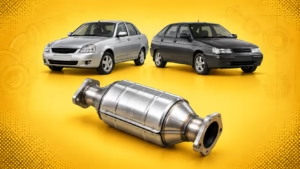
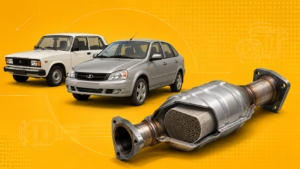
Sellers often say, “It came from a popular car, so it must be expensive.” That sounds logical, but it skips the real pricing factors. Two converters from the same brand can have very different value. Even two units from the same model year may not match.
Another common mistake is asking several buyers for a number while sending only one blurry photo. That usually brings broad estimates, not a true evaluation. If a buyer cannot identify the unit, they protect themselves by quoting low or by giving a wide range.
This is why many disputes start with expectations, not with the final inspection. The seller expected one number. The buyer was waiting for proof. Both were talking about price, but not about the same level of certainty.
Why is visual condition not enough?
No, visual condition is not enough. The outer shell tells only part of the story.
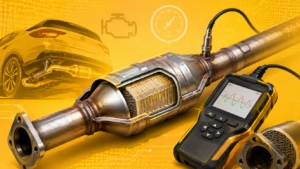
A converter can look intact and still be empty, contaminated, heavily worn, or made as a lower-value aftermarket unit. In contrast, a dirty or used unit may still hold solid recovery value if the internal material and identification marks are right.
Serious buyers check more than dents or rust. They look at the unit type, the markings, whether the core is present, and whether the converter has been cut open or altered. That is why a seller who says, “It looks fine,” may still receive a lower offer than expected.
Table: Common seller assumptions versus what buyers actually check
| Seller assumption | What a professional buyer checks | Why it changes the quote |
|---|---|---|
| The car brand decides everything | Part number, OEM status, and unit type | Many brands use several converter versions with different recovery value |
| A clean shell means high value | Internal core presence and condition | The shell can look good while the valuable material is damaged or missing |
| Any removed converter is the same | Original, replaced, cut, damaged, or aftermarket status | Not all removed units have the same metal content or resale path |
| One online figure fits all | Exact identification and inspection data | General averages hide major differences between similar-looking units |
| Fastest buyer gives the best deal | Method, transparency, and documentation | A fast promise can turn into a lower final payment after inspection |
What really affects a quote?
A fair quote depends on identification, internal content, and condition. The more clearly a buyer can verify those points, the more accurate the offer becomes.
The first factor is the exact unit itself. Part numbers, serial markings, and construction type matter. A converter from one engine variant may differ from another that looks almost the same from outside.
The second factor is what remains inside. According to the U.S. Department of Energy, platinum group metals are central to catalyst supply chains. That helps explain why recovery value depends on the material content, not just on the vehicle badge stamped somewhere else.
The third factor is condition. A cut housing, severe contamination, missing core material, or a unit that has already been tampered with can change the result. The buyer is not only buying a metal can. They are buying recoverable material and verifiable identity.
If you want a deeper technical explanation, see which metals are inside a catalytic converter. That background helps sellers understand why similar-looking units can produce very different quotes.
Does the car model alone decide value?
No, the car model alone does not decide value. It can point a buyer in the right direction, but it does not replace identification.
This is where many myths start. A seller hears that a certain Toyota, BMW, or Lexus converter is “always expensive” and expects the same result for every unit from that brand. Real pricing is more specific than that.
The automotive catalytic converter price depends on the actual converter fitted to the vehicle, not just on the logo on the trunk. Production changes, engine types, emission standards, and original versus replacement parts all matter.
So yes, vehicle make and model are useful. They are just not enough on their own.
Do damaged or cut units always have low value?
No, not always. Damage can reduce value, but it does not automatically make a unit worthless.
Much depends on what kind of damage occurred. A dented shell is one thing. A unit that has been cut open, emptied, badly contaminated, or mixed with other material is another. Once the buyer cannot trust the content or cannot identify the converter, the quote becomes more cautious.
This is one reason sellers should avoid doing “prep work” before asking for an offer. Trying to open the unit, clean it aggressively, or remove parts can create doubt and lower the final result.
Why do incomplete details lead to poor offers?
Incomplete details lead to poor offers because uncertainty costs money. When a buyer cannot confirm what you have, they either quote low or quote wide.
A message that says only “I have two converters from a Japanese car” is not enough. It does not tell the buyer whether the units are original, whether the cores are intact, or whether the parts can be identified at all.
Many sellers search generic phrases like prices for used catalytic converters and expect a ready-made answer. That search can help you understand the market, but it does not replace a proper evaluation of your own unit.
QazaqKat places strong focus on transparent pricing and accurate evaluation methods. If you want to see the logic behind that process, read how QazaqKat evaluates catalytic converters. It shows why clear information helps both sides reach a fair number faster.
What details should you send before asking for a price?
You should send clear photos, markings, quantity, and condition details. Those basics can sharply improve quote accuracy.
Start with the visible codes or part numbers on the housing. Then add photos from several angles. Mention whether the unit is removed, damaged, cut, or still complete. If you have several converters, sort them by type instead of sending one mixed pile photo.
Also say whether the converter is original or already replaced with an aftermarket unit, if you know. That one detail can prevent a lot of wasted time.
Table: Information that helps a buyer give a more accurate quote
| Information to provide | Why it matters | Simple tip |
|---|---|---|
| Part number or housing code | Helps identify the exact converter type | Photograph the code closely and in good light |
| Photos from multiple angles | Shows shape, cuts, welds, and overall condition | Send front, side, and code photos |
| Original or aftermarket status | These units can differ strongly in value | Say if the part was replaced before removal |
| Condition of the unit | Missing core or heavy damage can change the quote | State clearly if it is cut, cracked, clogged, or empty |
| Quantity and mix | Mixed lots need sorting for accurate evaluation | Group similar units together before sending photos |
| Vehicle details if known | Can support identification when codes are unclear | Include make, model, engine, and year if available |
Why do local myths create wrong expectations?
Local myths create wrong expectations because they replace evaluation with rumor. A city name or a popular ad does not tell you what your converter is truly worth.
People often search for catalytic converter price in Almaty and assume the answer should be a simple fixed number. Others look for expensive catalytic converter acceptance Almaty and expect the highest advertised figure to apply to their unit too.
That is where sellers go wrong. A local market term may help you find buyers, but it does not identify the converter in your hands. The same is true for broad phrases like “highest price in the city.” They sound clear, yet they say nothing about the exact unit, the condition, or the evaluation method.
For sellers in Astana, Almaty, or any other part of Kazakhstan, the better approach is simple: focus on the unit itself first, then compare how the buyer explains the quote. Geography may affect convenience and logistics, but technical identification still drives the real number.
Is an online average enough?
No, an online average is not enough. It is a rough reference, not a final answer.
Averages combine many different part types, conditions, and quality levels. That is why two sellers can both say they checked the market, yet one still gets a much lower quote than expected. The average did not match the actual unit.
If you use averages at all, use them only as a starting point. Then ask for an evaluation based on markings, condition, and clear photos. That is how you move from guesswork to a real offer.
Why do legal and sourcing questions matter?
Legal and sourcing questions matter because legitimate buyers must know what they are purchasing. Clear origin protects both the seller and the buyer.
Cases reported by the U.S. Department of Justice show that catalytic converter theft and illegal resale are real issues. For that reason, professional buyers may ask where the unit came from, whether it was removed from your own vehicle, or whether it comes from a workshop or dismantling source.
A seller who gets annoyed by these questions can mistake caution for a low-price tactic. In reality, origin checks are part of doing business responsibly. They help reduce risk and support a cleaner market for everyone.
Why does removal history matter?
Removal history matters because it gives context. It helps explain condition, originality, and whether the unit may have already been replaced before.
For example, a converter removed after failure may be clogged, contaminated, or heat-damaged. A unit taken from a dismantled vehicle may be intact but old. A replacement part installed years ago may not carry the same value as the original factory part.
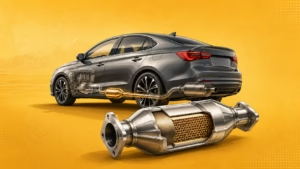
If you are not sure where the converter sat in the vehicle, QazaqKat has a useful guide on where the catalytic converter is located in your car. That can help private owners describe what they are selling more clearly.
How can you avoid leaving money on the table?
You can avoid leaving money on the table by preparing the right details and choosing a buyer who explains the quote. Good pricing starts before the inspection.
First, gather information. Find any visible codes. Take several sharp photos. Note whether the unit is original, replaced, damaged, or cut. If you have multiple pieces, sort them.
Second, understand why catalytic converters are bought up. Buyers are not paying for a random used car part. They are paying for identifiable units that can be responsibly processed and recycled, with recoverable precious metals returned to the supply chain.
Third, compare how buyers communicate. A fair buyer should explain what they need from you, how they assess the unit, and why one converter differs from another. Vague promises may sound attractive, but they often hide uncertainty.
Should you clean, open, or break the unit before selling?
No, you should not. Leave the converter as it is.
Opening or breaking it can destroy useful identification clues and raise concerns about missing material. Even heavy cleaning can create questions if codes become harder to read or if the buyer suspects tampering. A natural, clearly photographed unit is usually easier to evaluate than one that someone has tried to “improve.”
- Keep the converter complete and unopened
- Photograph visible codes in good light
- Send front, side, and code photos
- Note if it is original, replaced, damaged, or cut
- Do not open or break the housing
- Do not do aggressive cleaning
- Do not remove parts to make it look better
- Do not send only one blurry photo
When should you compare more than one quote?
You should compare more than one quote when the unit is identifiable and the offers differ without clear explanation. Comparison works best when each buyer has the same details.
Send the same photos and notes to each buyer. Then compare not only the number, but also the method. Did they ask about markings? Did they explain the condition factors? Did they clarify whether the quote was preliminary or final? The best deal is not always the loudest one.
Why is a transparent buyer worth more than a quick promise?
A transparent buyer is worth more because clear evaluation reduces surprises. You are less likely to face a sharp price drop later.
QazaqKat operates across Kazakhstan, with its main location in Astana, and focuses on fair communication, accurate evaluation, and responsible recycling. That matters for private sellers, workshops, dealers, dismantling yards, and industrial partners alike.
When the process is clear, sellers understand what affects the number. They can ask better questions, provide better information, and avoid common mistakes that weaken the deal. A structured catalytic converter acceptance process is often the difference between a realistic quote and a frustrating one.
Summary
Sellers usually go wrong on price when they expect certainty without evidence. They rely on model myths, city-based claims, or broad online averages instead of part numbers, condition, and clear photos. The result is simple: unclear input leads to rough offers, and rough offers are often lower than expected.
If you want a fair outcome, focus on the factors that actually influence value. Identify the unit. Share complete information. Avoid altering it before inspection. Compare explanations, not just numbers. For sellers across Kazakhstan who want a transparent, responsible route, QazaqKat offers a trusted way to assess and recycle converters with clear communication and professional support.
FAQ
Can I get an accurate quote from one photo?
Usually not. One photo may help start the conversation, but accurate quotes often need visible markings, multiple angles, and condition details.
Does an original factory converter usually matter more than an aftermarket one?
Yes, it often does. Original units can differ from aftermarket replacements in identification and recoverable material, which can affect the quote.
Will a clogged converter always be worth less?
Not always. A clogged unit may still have value, but the final quote depends on identification, internal condition, and whether the converter remains complete and untampered.
Why do buyers ask where the converter came from?
They ask because legal origin matters. Responsible buyers need to reduce risk, verify source, and keep the transaction clear and compliant.
What is the safest way to prepare a converter for sale?
Leave it intact, keep any visible codes readable, and send clear photos with honest condition notes. That gives the buyer the best chance to evaluate it fairly.