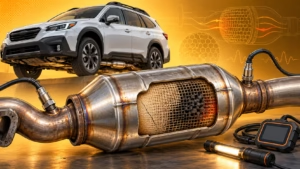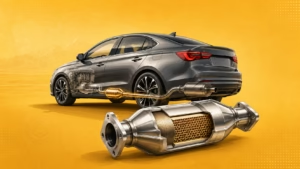
Introduction: A Subaru uses an exhaust converter to reduce harmful emissions before gases leave the tailpipe. When the unit, an oxygen sensor, or the engine control system has a problem, the check-engine light may appear. Drivers may also notice poor acceleration, noise, higher fuel use, or an emissions-test failure. Yet these signs do not prove that the catalytic converter has failed. A full diagnosis should come before parts are ordered or removed.
Key Takeaways
- A fault code alone does not confirm converter failure.
- Misfires, oil burning, coolant leaks, and fuel faults can damage the unit.
- Rattling, heat, and severe power loss need quick attention.
- Check sensors, exhaust leaks, and engine condition before replacement.
- Subaru model, year, engine, and emissions rules affect parts and labor.
- Repair the root cause or the replacement may fail early.
What does the exhaust converter do in a Subaru?
It treats exhaust gases as they pass through the exhaust system. Its internal material helps change harmful gases into less harmful forms before they reach the air.
The engine control system checks how well this process works. Oxygen sensors placed before and after the converter send data to the vehicle’s computer. If the readings suggest low efficiency, the computer may turn on the check-engine light and store a fault code.
That code is a starting point, not a final verdict. A damaged sensor, an exhaust leak, an incorrect fuel mixture, or an engine fault may produce similar results. For a broader explanation of the system, see this guide to the purpose and maintenance of a vehicle converter.
What are the common signs of a failing Subaru converter?
Common signs include a warning light, weak acceleration, rattling, unusual exhaust odor, excess heat, poor fuel economy, and a failed emissions inspection. Some symptoms are mild, while others may mean that driving should stop.
Why is the check-engine light on?
The light comes on when the engine computer detects a fault that can affect engine operation or emissions. It does not identify the failed part by itself.
Low-efficiency codes often lead owners to suspect the converter first. However, stored codes must be read with freeze-frame data, misfire information, fuel correction data, and oxygen-sensor readings. According to the US Environmental Protection Agency, on-board diagnostics monitor emissions-related systems and alert the driver when a fault is detected.
What do common symptoms suggest?
Each symptom points to several possible causes. The table below shows what a driver may notice and the sensible first response.
| Symptom | What it may indicate | Recommended response |
|---|---|---|
| Steady check-engine light | Efficiency, sensor, fuel, ignition, or exhaust fault | Read the stored codes and arrange diagnosis soon |
| Flashing check-engine light | Active misfire that may overheat the exhaust unit | Reduce load and stop driving if the engine runs poorly |
| Weak acceleration | Restricted exhaust, engine fault, or fuel problem | Avoid hard driving and have exhaust flow checked |
| Rattle under the vehicle | Loose heat shield or damaged internal material | Request a physical inspection before replacing parts |
| Sulfur-like smell | Fuel mixture, combustion, or exhaust-treatment problem | Check engine operation and fuel control |
| Excess heat | Unburned fuel reaching the exhaust or a restriction | Stop if there is smoke, severe heat, or loss of power |
| Failed emissions test | Stored fault, incomplete monitor, leak, or low efficiency | Keep the test report and complete a full diagnosis |
When should the vehicle not be driven further?
A steady light with normal engine operation may allow a short trip to a workshop. Even then, delaying diagnosis can make the repair larger. If the engine shakes, stalls, smells strongly of fuel, or struggles to move, arrange safe transport instead of continuing the journey.
What causes converter damage in Subaru vehicles?
Converter damage often begins elsewhere in the vehicle. Ignition faults, fluid consumption, sensor errors, fuel-system defects, and exhaust leaks can all affect temperature or exhaust readings.
How do misfires harm the exhaust system?
A persistent misfire can send unburned fuel into the exhaust. That fuel may burn inside the converter and create damaging heat.
Possible sources include ignition, fuel delivery, air leaks, or internal engine problems. The exact cause must be tested. Replacing the exhaust unit while leaving an active misfire will not provide a sound long-term repair.
Can oil or coolant cause early failure?
Yes. Oil or coolant entering the combustion chamber may contaminate the internal surface and reduce its ability to treat exhaust gases.
Check the engine oil level and condition. Look for unexplained loss between services. The cooling system should also be checked if coolant falls with no clear external leak. Smoke, deposits, or fluid loss must be assessed before a new unit is fitted.
Can sensors and exhaust leaks create misleading codes?
Yes. Slow or damaged oxygen sensors and leaks near the sensors can change the data seen by the engine computer. The resulting code may look like a converter fault.
Wiring, connectors, sensor response, and exhaust joints all need attention. Fuel pressure and injector operation may also matter when the mixture stays too rich or too lean. A technician should compare live readings rather than replace a sensor based only on a code description.
How should a Subaru converter problem be diagnosed?
Diagnosis should move from engine condition to sensor data and then to the exhaust unit itself. This order reduces the chance of replacing a costly part that is still working.
- Read all stored and pending codes. Record them before clearing anything. Freeze-frame data can show engine speed, load, and temperature when the fault appeared.
- Check for active misfires. Rough running, ignition faults, and cylinder-specific counts need attention first.
- Inspect for exhaust leaks. Examine joints, gaskets, pipes, and areas near the oxygen sensors.
- Review oil and coolant condition. Note fluid loss, smoke, contamination, or signs of internal leakage.
- Assess fuel control. Review fuel correction data and check for injector, pressure, or air-intake faults.
- Test oxygen-sensor activity. Compare upstream and downstream data under suitable operating conditions.
- Confirm restriction or internal damage. An exhaust specialist can use suitable tests and a physical inspection.
Owners who want to understand the checks can review this practical article on how to test whether a converter is bad. Testing near a hot exhaust requires care, so workshop diagnosis is safer when tools or experience are limited.
A professional assessment of a removed car catalytic converter can also support responsible recycling. However, removal should happen only after the fault has been confirmed and a lawful replacement plan is ready.
Why should emissions equipment never be bypassed?
Removing, emptying, or bypassing the unit does not repair the engine fault. It can increase emissions, cause recurring warning lights, and conflict with local vehicle rules.
Software changes that hide an efficiency code also leave the physical problem unresolved. The sound approach is to fix the engine or sensor fault, install the correct emissions part, and confirm that the monitoring system completes its checks.
How do Legacy, Forester, and Outback repairs differ?
Fitment and repair effort can differ by production year, engine generation, drivetrain layout, and emissions specification. The vehicle identification number and exact engine details should guide the parts search.
What should Legacy owners check?
Legacy owners should confirm the year, engine, exhaust layout, and required emissions specification. Similar-looking parts may not share the same sensor positions or connections.
A listing for a Subaru Legacy catalytic converter should be checked against the vehicle identification number. The workshop should also inspect nearby pipes, shields, sensors, and mounting points before giving a final estimate.
What should Forester owners check?
Forester owners need a diagnosis that considers both engine faults and exhaust fitment. Access and labor can change with the engine and drivetrain arrangement.
Before buying a Subaru Forester catalytic converter, ask the supplier or repairer to confirm production year, engine details, sensor ports, and emissions specification. A part that fits physically may still be wrong for the control system.
What should Outback owners check?
Outback owners should avoid estimates based only on the model name. Year, engine, exhaust position, part type, and related repairs all affect the total.
The price of catalytic converter for Subaru Outback cannot be assessed well without vehicle details and an inspection. One estimate may cover only the part, while another may include sensors, gaskets, damaged pipes, labor, testing, and disposal of the old unit.
The same rule applies to any Subaru catalytic converter. Confirm fitment by vehicle data rather than appearance, engine capacity alone, or a general model description.
Which replacement type should a Subaru owner choose?
The right choice depends on legal requirements, fit, expected service life, warranty terms, and the vehicle’s condition. The cheapest unit is not always the least costly over time.
How do replacement choices compare?
Genuine, direct-fit aftermarket, universal, and used units have different strengths and limits. This table shows the practical points to discuss with the repair workshop.
| Replacement type | Main benefit | Main limitation | Questions to ask |
|---|---|---|---|
| Genuine part | Designed for the specified vehicle application | May involve a higher initial expense | Does the part match the VIN and emissions specification? |
| Reputable direct-fit aftermarket part | Made for installation without custom fabrication | Quality and legal acceptance can vary | What approval, warranty, and fitment evidence is supplied? |
| Universal unit | May suit applications where fabrication is practical | Needs skilled cutting, fitting, and welding | Will sensor position, flow, clearance, and legal compliance remain correct? |
| Used component | May be available where local rules allow it | Its history, contamination, and remaining life may be unclear | Can its identity, condition, source, and legal use be verified? |
Rules for aftermarket parts differ by location. For example, the California Air Resources Board sets specific requirements for aftermarket converters used in California. Subaru owners should confirm the rules that apply where the vehicle is registered and used.
Warranty terms also deserve attention. Ask what the warranty covers, which installation records must be kept, and whether unresolved engine faults can affect a claim. Retain the diagnostic report and proof that related problems were repaired.
Why does replacement cost vary so much?
Cost changes because Subaru vehicles do not all use the same exhaust layout, parts, sensors, or repair access. A sound estimate needs more than the make and model.
Key cost factors include:
- Vehicle production year and engine size
- Engine generation and drivetrain layout
- Number and position of exhaust-treatment components
- Genuine, direct-fit, universal, or legally suitable used part
- Access time and the condition of fasteners and pipes
- Oxygen-sensor condition
- Gaskets, shields, joints, and mounting hardware
- Misfire, oil, coolant, fuel, or wiring repairs
- Local emissions requirements
- Post-repair testing and code verification
A workshop should request the VIN, engine information, stored codes, recent repair history, and emissions-test results. A visual inspection can then identify leaks, corrosion, impact damage, poor prior repairs, and sensor issues.
Do not compare estimates until you know what each one includes. One quote may cover a bare part. Another may cover diagnosis, fitting materials, labor, sensor work, testing, and warranty support. These are not equal offers.
What should owners do after the repair?
- Keep the original diagnostic printout and repair invoice.
- Confirm the exact replacement part number and warranty terms.
- Ask whether all misfire, fuel, oil, coolant, and sensor issues were repaired.
- Check that no exhaust leak or rattle remains.
- Test-drive the vehicle under suitable conditions.
- Have the system scanned again if the warning light returns.
- Send the removed unit to a responsible purchaser or recycling service.
Never discard the old unit with ordinary waste. In Kazakhstan, owners and automotive businesses can request an assessment and discuss the catalytic converter price with Qazaqkat. The company serves private owners, dealerships, workshops, dismantling yards, and industrial partners across the country.
Summary
A warning light or failed emissions test does not automatically mean that a Subaru needs a new exhaust converter. Start with stored codes, engine condition, fluid use, fuel control, sensor data, and exhaust leaks. Confirm internal damage or restriction before ordering a part.
When replacement is necessary, match the unit to the VIN, engine, model year, and emissions specification. Compare the full repair scope, not just the part. Qazaqkat can assist with the professional purchase, acceptance, and responsible recycling of removed units in Kazakhstan. Clients can call +7 708 838 63 26 or +7 707 470 85 33, email info@qazaqkat.kz, or visit 9 Kendala Street, Astana 010006.
FAQ
Can I drive a Subaru with a suspected failed converter?
A short trip to a workshop may be reasonable if the check-engine light is steady and the vehicle runs normally. Stop driving if the light flashes, acceleration drops sharply, the engine shakes, or the exhaust area becomes very hot. These signs may point to an active misfire, severe restriction, or another fault that could cause further damage.
Can a faulty oxygen sensor cause similar warning codes?
Yes. A slow, damaged, or poorly connected oxygen sensor can send data that resembles low converter efficiency. Exhaust leaks near the sensor may also distort its readings. A technician should inspect wiring and connections, check for leaks, and review live upstream and downstream sensor data before deciding which part has failed.
Does an efficiency code prove that replacement is required?
No. An efficiency code reports that the monitored exhaust results fell outside the expected range. It does not prove why that happened. Misfires, fuel-mixture faults, oil consumption, coolant entry, sensor problems, and exhaust leaks should be checked first. Replacement makes sense only after tests support internal damage, contamination, or flow restriction.
How can I avoid replacing the unit too early?
Keep the stored codes and freeze-frame data, then ask for a full engine and exhaust diagnosis. The workshop should check misfires, fuel control, oxygen sensors, leaks, oil use, and coolant condition. Do not approve replacement based only on a code description. Request test results and a clear explanation of the confirmed failure.
What information is needed for an accurate repair estimate?
Provide the VIN, production year, engine details, drivetrain information, fault codes, emissions-test report, and recent service history. The workshop should inspect the exhaust layout, sensors, joints, pipes, and mounting hardware. It should also identify any engine fault that caused the damage. This creates a more useful estimate for parts, labor, related repairs, and testing.