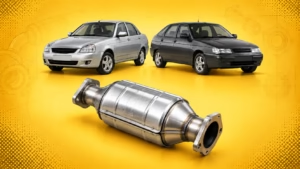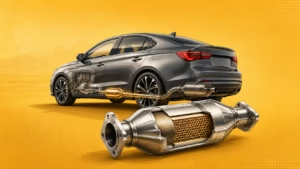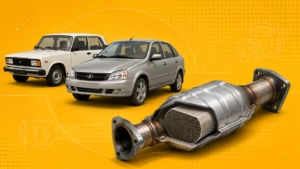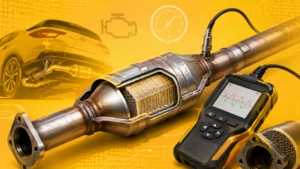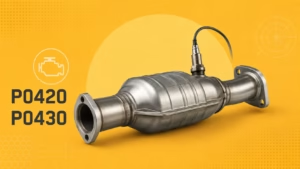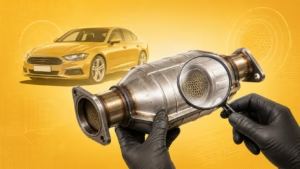
Introduction: Diesel exhaust parts get mixed up a lot in Kazakhstan, especially when people say “the catalyst” but mean the filter. The confusion matters because a diesel oxidation catalyst and a diesel particulate filter do different jobs, fail in different ways, and have different recycling value. If you want a clear, fair path to sell or recycle a unit, Qazaqkat can help you identify your part and handle the diesel engine catalytic converter correctly.
Key Takeaways
- A diesel oxidation catalyst (DOC) and a DPF are not the same part, even if they sit in the same exhaust section.
- A DPF mainly traps soot, while a DOC mainly converts gases like CO and hydrocarbons.
- Many diesel cars have both DOC and DPF, so “one box” can hold more than one element.
- DPF issues often show up as regeneration problems and rising backpressure, not just a bad smell.
- Correct identification protects you from paying for the wrong repair or selling the wrong unit.
- For recycling, the catalyst section is usually the key target, but each unit must be assessed case by case.
Why are diesel catalysts and DPFs confused in Kazakhstan?
People use simple words at the workshop: “catalyst,” “bank,” “barrel,” or “flask.” That works until you need a repair, diagnostics, or recycling.
- Many diesel systems combine parts in one housing, so it looks like a single unit.
- Some scan tools show generic fault texts, which leads to wrong guesses.
- Used parts get sold with vague labels, so buyers repeat the same mistake.
- Owners often notice smoke or a warning light and assume “catalyst problem,” even when the DPF is the issue.
If you want a solid baseline before you talk to a service or recycler, Qazaqkat’s article Catalytic Converter in a Car: Purpose, Operation, and Maintenance is a helpful reference. It keeps terms clear, which saves time when you speak with mechanics.
Also, it helps to remember the pillar guide title: Catalytic Converter in a Car: Purpose, Operation, and Maintenance – Qazaq Kat. Use it as a mental checklist: purpose, operation, and maintenance are different for each aftertreatment part.
What does a diesel oxidation catalyst do?
A diesel oxidation catalyst (DOC) is a catalyst designed to treat gases in the exhaust stream. Its job is to promote chemical reactions that reduce harmful components in the exhaust.
In practical terms, the DOC helps convert carbon monoxide and unburned hydrocarbons into less harmful compounds. According to Cummins aftertreatment overview, diesel aftertreatment systems use different components for different pollutants, and the oxidation catalyst is one of the core building blocks.
Owners usually do not “feel” a DOC working. When it fails or gets damaged, you may see fault codes, higher emissions, or poor downstream performance (for example, other components may struggle).
What is a DPF and what does it trap?
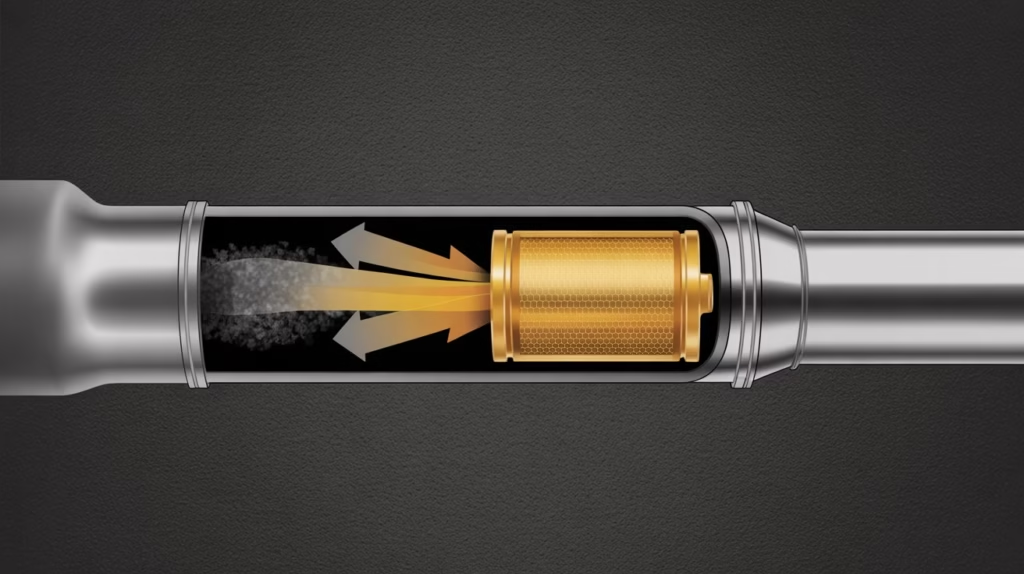
A DPF (diesel particulate filter) is a physical filter. It captures particulate matter (soot) from exhaust gas and stores it in the filter channels. Over time, that soot load must be reduced.
The common way the system manages soot is catalytic converter regeneration (many drivers shorten this to “regen”). In normal talk, people say “my catalyst regenerates,” but the process is usually about the filter section getting hot enough to burn off soot.
For a simple definition that matches how drivers experience it, Wikipedia Diesel particulate filter describes the DPF as a device designed to remove diesel particulate matter from exhaust gas.
Is the DPF a catalytic converter?
No. If you are asking is the DPF a catalytic converter, treat the answer as “not by default.” A DPF is a filter first.
However, some DPF units have catalytic coatings or sit next to a DOC in the same housing. That is why people confuse them. From the outside, it can look like “one catalyst,” even when you actually have two functions packed together.
Action step: when a shop gives you a quote, ask them to write “DOC,” “DPF,” or “DOC + DPF assembly” on the invoice. That single line prevents most misunderstandings later.
Where does the aftertreatment sit on a diesel car?
Placement depends on the model, but the logic is simple: the system sits in the exhaust line, often closer to the engine on newer cars. Heat helps the parts work.
When you hear the phrase exhaust gas catalytic converter, people usually mean “the catalyst unit mounted in the exhaust.” For recycling or sale, that wording is still too broad, so you want the exact part type and housing style.
If you plan to sell a unit for recycling, Qazaqkat’s exhaust gas catalytic converter intake process focuses on accurate identification and transparent evaluation, which is critical when a housing may contain more than one element.
Comparison table: What DOC and DPF differences look like in real life
This table shows the practical differences you can use to identify what you have and what service is usually relevant.
| Feature | Diesel oxidation catalyst (DOC) | Diesel particulate filter (DPF) |
|---|---|---|
| Main job | Treats gases through catalytic reactions | Traps soot (particulate matter) in a filter structure |
| Common driver symptom | Often subtle until fault codes or performance issues appear | Warning lights, forced regen requests, power reduction on some cars |
| Typical “maintenance” talk | Inspection for damage, contamination, or incorrect fueling history | Regen behavior, soot load checks, cleaning decisions |
| When owners confuse it | Called “DPF” because it sits near the filter | Called “catalyst” because it sits in a metal can like a catalyst |
| Recycling relevance | Often evaluated for precious metal content case by case | May be part of an assembly; value depends on design and condition |
How can you tell which part you have without guessing?
You do not need advanced tools to reduce guesswork. Start with what you can verify.
- Read the casing marks. Many housings have stamped codes. Take a clear photo.
- Check the service history. If the car often requests regen, that points toward the filter side.
- Look at the fault code text. Ask for the exact code, not just “DPF error.”
- Ask whether the unit is a combined housing. “DOC + DPF” assemblies are common.
If you want a quick refresher on the basic terms before you call a workshop, Qazaqkat also has a plain-language explainer: Catalytic Converter Explained Simply.
What about lifespan and repair expectations?
Drivers often ask for one number, but real life depends on fuel quality, driving cycles, oil consumption, and how fast problems get fixed.
Still, it helps to separate topics:
- catalytic converter lifespan is usually discussed in terms of catalyst contamination, thermal damage, and mechanical break-up.
- service life of a catalytic converter is a practical view: how long it stays effective before faults, restrictions, or inspection failures show up.
- restoration of a car catalytic converter gets misunderstood. Some services clean housings or remove soot, but that does not always restore catalyst chemistry. Always ask what the service actually changes and what it only “washes.”
If a seller promises a “like new” result with no measurements, treat that as a warning sign. Ask for test data, photos, and clear terms.
When does recycling make more sense than repair?
Choose recycling when the unit is damaged, melted, heavily contaminated, or when repeated faults return after cleaning. Repair attempts can cost time and still end with replacement.
Recycling also makes sense when you have removed parts from a dismantling yard, a workshop backlog, or a fleet maintenance cycle and you want clear, consistent handling.
Qazaqkat supports private owners, car services, dismantlers, and industrial partners across Kazakhstan, with a primary location in Astana. If you need a transparent path for an auto catalytic converter or a diesel assembly that includes catalyst elements, the key is correct identification first, then evaluation, then safe processing.
For a complete overview of this topic, read Catalytic Converter Basics for Kazakhstan Drivers.
Summary
DOC and DPF parts solve different problems: the DOC treats gases, while the DPF traps soot. They are often combined in one housing, which explains the common mix-up in Kazakhstan. Clear naming helps you avoid the wrong repair and sets you up for a smoother sale or recycling process.
If you are in Astana or anywhere in Kazakhstan and want a fast, clear check of what you have, Qazaqkat can guide you through identification and handle purchasing and recycling with transparent evaluation and responsible processing.
FAQ
Can a diesel car have both a DOC and a DPF?
Yes. Many diesel systems use a DOC and a DPF, sometimes as separate cans, sometimes combined in one housing. Ask your workshop to label the assembly clearly.
What is the quickest way to avoid buying the wrong used part?
Match the stamped code on the casing, not just the seller’s description. Take photos and confirm the exact component type (DOC, DPF, or combined).
Does a DPF problem always mean you need a new filter?
No. Some cases relate to driving style, sensors, or soot load management. Get the exact fault codes and a soot load reading before you decide.
Why do people call everything a “catalyst”?
Because several aftertreatment parts sit inside similar metal housings in the exhaust line. The outside can look the same even when the inside function differs.
What should I prepare before I contact a recycler?
Bring clear photos of the unit, any visible codes, and the vehicle details if available. That speeds up identification and helps the recycler advise the right next step.