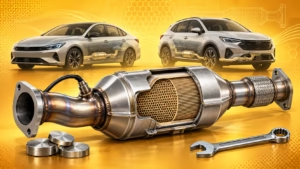
Introduction: A warning light or loss of power does not prove that a converter needs replacement. Testing a catalytic converter in a car means checking exhaust flow, sensor signals and the condition of its inner core. Each test answers a different question. This workshop-floor guide explains what home checks can reveal, how service centers test a suspect unit, and why a sound diagnosis can prevent needless removal. All figures below are typical guide values, not substitutes for the vehicle manufacturer’s service data.
Key Takeaways
- Warm the engine fully before testing.
- Separate exhaust blockage from poor catalyst efficiency.
- Use pressure readings to check for restricted flow.
- Compare oxygen sensor graphs, not just fault codes.
- Use a borescope to look for visible core damage.
- Fix engine faults before fitting a new converter.
How should a workshop prepare for converter diagnosis?
A workshop should start converter diagnosis with a full warm-up, a fault-code scan and checks for engine faults or exhaust leaks. Cold readings can mislead, while a misfire or fuel-control problem can make a sound converter appear faulty. Record stored and pending codes, freeze-frame data and the driver’s symptoms before clearing anything. Then follow the test conditions in the vehicle manufacturer’s service data.
Local weather matters. The World Meteorological Organization lists January average daily lows in Astana at about -22 C. During long winters, short trips may end before the converter and sensors reach full working temperature. A brief spell at idle is not a reliable substitute for the prescribed warm-up.
Run tests with proper exhaust extraction and keep clear of hot parts. Work under the vehicle requires rated lifting equipment, not a jack alone. Sensor removal and running-engine pressure tests belong in a workshop if you lack the tools or experience. High-voltage hybrid systems are outside this guide.
Which workshop tests reveal converter faults?
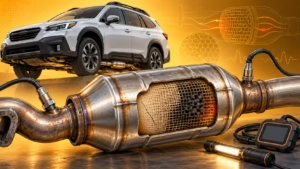
Workshop tests reveal different faults: pressure tests check flow, sensor analysis checks oxygen-storage behavior, and a borescope shows visible damage. No single method proves every aspect of converter health. A unit may flow freely yet clean exhaust poorly, or have a damaged core that restricts flow. The strongest diagnosis combines the symptoms with two or more checks that support the same conclusion.
Converter test comparison: tools, evidence and limits
| Method | What it measures | Typical tools | What it can and cannot prove |
|---|---|---|---|
| Back-pressure test | Resistance to exhaust flow | Low-pressure gauge and sensor-port adapter | Shows restriction, but does not prove catalyst efficiency or locate every blockage. |
| Intake vacuum test | Manifold vacuum over time | Vacuum gauge | Supports a restriction diagnosis; engine faults can also affect readings. |
| Sensor analysis | Upstream and downstream signal patterns | Live-data scan tool or oscilloscope | Helps assess oxygen storage; leaks and sensor faults can confuse results. |
| Temperature check | Inlet and outlet surface heat | Infrared thermometer | Supports other findings, but cannot prove failure alone. |
| Borescope inspection | Visible core condition | Camera through a sensor port | Reveals visible damage, not the whole core or chemical performance. |
| Exhaust gas analysis | Exhaust gas levels | Four-gas or five-gas analyzer | Supports an emissions diagnosis; engine condition also affects results. |
How do pressure and vacuum tests find a restriction?
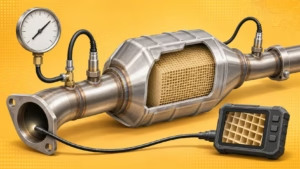
Pressure and vacuum tests find a restriction by showing whether exhaust flow becomes harder as engine speed rises. For checking the catalytic converter with a manometer, a technician fits a suitable gauge into the upstream oxygen sensor port. Readings above the typical limits below point to restricted exhaust flow, but further checks must establish whether the blockage sits in the converter or elsewhere.
Typical pressure and vacuum guide values for a warm engine
| Test condition | Typical guide value | Warning sign |
|---|---|---|
| Exhaust pressure at idle | About 1.25 psi, or 8.6 kPa, or less | A higher reading suggests restriction. |
| Exhaust pressure at 2,500 rpm | About 3 psi, or 20 kPa, or less | Excess pressure supports a blockage finding. |
| Intake vacuum at warm idle | Usually a steady 17-21 inHg | Low or unstable vacuum needs further checks. |
| Intake vacuum held near 2,500 rpm | No slow, sustained decline | Vacuum that slowly falls suggests exhaust restriction. |
Do
- Use manufacturer limitsFollow the manufacturer’s limits wherever available.
- Read the vacuum trendAccount for altitude and engine design. A slow fall at steady speed is more useful than one low reading.
- Consider downstream blockageA blockage farther downstream can raise pressure measured ahead of the converter.
Avoid
- Universal cutoffsDo not put general guide values ahead of manufacturer data.
- Single-reading conclusionsDo not judge vacuum by one low number without considering the pattern and engine context.
- Blaming the converter automaticallyHigh pressure ahead of the converter does not prove that the converter itself is blocked.
What should oxygen sensor graphs and temperature checks show?
Upstream vs. downstream signals
Upstream narrowband sensor
Downstream sensor
Compare both graphs under the maker’s stated test conditions. Similar fast switching can point to low efficiency, as flagged by P0420 for bank 1 or P0430 for bank 2. However, check leaks, fuel control and sensor response before blaming the core. The phrase catalytic converter sensor often means an oxygen sensor; its location and design matter. The guide to low-efficiency fault codes gives useful context for drivers reading a scan report.
After full warm-up, an infrared check will often show a hotter outlet than inlet. A rise of about 10% or more is a common workshop rule of thumb, not a universal pass mark. Surface finish, measurement point and engine load affect results. An outlet that is not hotter can suggest weak catalyst activity, but cannot prove failure alone. Nor does every vehicle have a dedicated catalytic converter overheating sensor; confirm the fitted equipment from service data.
What can endoscopy and exhaust gas analysis confirm?
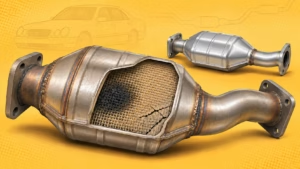
Endoscopy can confirm visible core damage, while exhaust gas analysis can support a finding that the converter is not treating exhaust properly. During catalytic converter endoscopy, a technician feeds a borescope through a suitable sensor port. The camera may reveal melted cells, cracks or deposits consistent with oil or coolant contamination. A clean view of one area does not prove that the whole core is sound.
A four-gas analyzer measures HC, CO, CO2 and O2; a five-gas unit adds NOx. Readings help assess combustion and exhaust treatment under controlled test conditions. The U.S. Environmental Protection Agency explains how on-board diagnostics watch emission-control parts and why a warning light should be checked rather than ignored. Gas results need context because engine faults and air entering through leaks can alter the readings.
Ask the workshop to save clear images and test results. A report that pairs visible damage with pressure or emissions evidence is more useful than a verdict based on one unclear camera image. It also helps explain why replacement is necessary.
Why are home checks not enough?
Home checks are not enough because a noise, smell or fault code cannot separate converter damage from other engine and exhaust faults. Tapping the shell may reveal a loose part, but silence does not prove a sound core. A sulphur smell is a clue, not a diagnosis. Likewise, one scan-tool code identifies a system concern rather than the part that must be replaced.
At home, note when power drops, whether the warning light flashes and which codes appear. Keep that record for the technician rather than clearing codes at once. For a broader view of safe checks, see the guide to testing a suspect converter. Avoid striking the shell or removing hot sensors to seek a quick answer.
What must be fixed before a converter is replaced?
Fix the cause before replacing the converter
Misfires
Oil burning or coolant leaks
Before fitting a replacement
- Confirm the cause
- Fix the fault
- Repeat the tests
The repair record should include relevant fault codes, test conditions and measured results. Where practical, repeat the checks after correcting the engine fault. A clear before-and-after record helps prevent needless parts replacement and gives the owner a sound basis for the next step.
Summary
A reliable diagnosis separates restricted flow from poor exhaust treatment and traces either fault back to its cause. Pressure readings, sensor graphs, camera images and gas checks each add evidence; none should stand alone. Once a workshop confirms that a car catalytic converter must be replaced, QazaqKat in Astana can assess and buy the old unit. Contact the team at Kendala St 9 or +7 708 838 63 26 to discuss assessment and handover.
FAQ
Does P0420 always mean the converter needs replacement?
No. P0420 reports low catalyst efficiency on bank 1, but it does not prove which part caused the result. Exhaust leaks, sensor faults and engine running problems need checks first. A workshop should review live data and supporting test results before recommending removal or replacement.
Can a converter be blocked without an efficiency code?
Yes. Restricted exhaust flow and low catalyst efficiency are different faults, so a blockage does not require an efficiency code to be present. Pressure testing helps assess flow. A vacuum trend can support the finding, while further inspection helps locate the restriction before any parts are removed.
Is an infrared temperature test enough on its own?
No. An infrared temperature test is a supporting check, not a final verdict. The engine must be fully warm, and the technician must compare suitable points under consistent conditions. A small temperature difference needs follow-up with sensor data, pressure testing or other checks suited to the symptoms.
Can a borescope prove that the core is healthy?
No. A borescope shows only the surfaces within its view. It can reveal clear damage, such as melted cells or cracks, but cannot confirm the chemical activity of the coating. Areas beyond the camera’s sight may also contain damage, so a normal image does not rule out failure.
Should the old unit be sold before diagnosis is complete?
No. Complete the diagnosis and confirm the repair plan before handing over the old unit. The workshop may still need it for inspection or comparison with test findings. Once replacement is confirmed, ask QazaqKat about assessment and purchase, and retain the workshop’s report for your records.