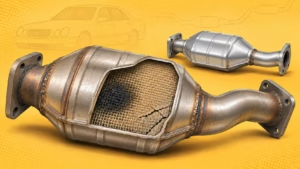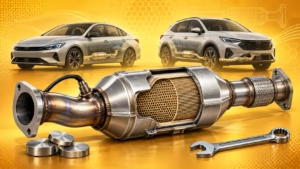
Introduction: A Mercedes catalytic converter treats harmful gases as they pass through the exhaust. Most owners give it little thought until a warning light appears, the car loses power, or a rattle starts beneath the floor. Those signs deserve a check, but they do not prove that the part needs replacing. Before you buy a new unit or sell the old one, confirm the fault and identify the exact part. For owners in Kazakhstan, Qazaqkat provides car catalytic converter purchasing and recycling services, with a primary location in Astana.
Key Takeaways
- A warning light alone does not prove that the exhaust catalyst has failed.
- Fix misfires and other engine faults before fitting a replacement.
- Match replacement parts by VIN, engine details, and part reference.
- W124, W202, W210, and W211 cars need vehicle-specific checks.
- Used value depends on the exact unit, not just the Mercedes badge.
- Keep removed parts intact and compare clear, written quotes.
What symptoms suggest a Mercedes exhaust catalyst fault?
Catalytic converter fault—or something else?
Possible warning signs
- Check-engine light
- Loss of power
- Exhaust noise
- Failed emissions test
- Changes in fuel use
Other faults to consider
- Worn spark plugs
- Faulty ignition coils
- Injector faults
- Oxygen sensor faults
- Air leaks
Pay attention to when the problem occurs. A rattle at idle calls for a different check from power loss under load. Loose heat shields and damaged exhaust parts can make noise without a failed catalyst core. Likewise, an engine that runs poorly may trigger exhaust-related warnings even when the catalytic converter is not the root cause. Tell the workshop whether the fault appears on cold starts, after long drives, or only during hard acceleration.
Mercedes warning signs
Seek prompt advice if you notice…
- A flashing engine warning light
- Severe rough running
- A sharp loss of power
What to do next
- 1Avoid repeated test drivesDo not keep driving to see whether the fault clears.
- 2Record the symptomsNote any recent repairs, too.
- 3Contact a qualified technicianAsk for prompt advice.
How should you diagnose the problem before replacing parts?
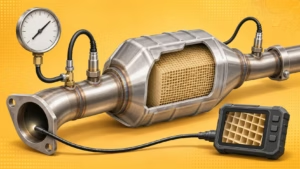
Diagnosis should combine fault-code checks, an engine assessment, and a physical exhaust inspection before anyone condemns the catalytic converter. A stored code can point toward a fault, but it does not replace testing. The technician needs to establish whether the problem involves poor catalyst performance, restricted exhaust flow, a sensor signal, or an engine fault that affects the readings.
Ask the workshop to record the codes before clearing them. Codes such as P0420 or P0430 relate to catalyst-system efficiency, but the full diagnosis must consider other faults and test results. Qazaqkat’s guide to low-efficiency fault codes offers further context for that discussion. A useful repair report explains both what the technician found and why a replacement is needed.
- Read all stored faults: Check for engine and sensor faults alongside exhaust-related codes.
- Inspect the exhaust: Look for leaks, impact damage, loose shields, and damaged joints.
- Check engine health: Investigate persistent misfires, fuel-control faults, and signs of oil or coolant entering the exhaust.
- Confirm the suspected failure: Have a qualified technician test for restriction or poor catalyst performance.
- Agree on the repair sequence: Resolve the cause before fitting a new unit.
Replacing the exhaust part while leaving an engine fault in place can put the new unit at risk. Ask for separate estimates for the underlying repair and the exhaust work. That makes the total bill easier to assess and helps you avoid paying twice for the same unresolved problem.
Which replacement choice makes sense for your Mercedes?
The right replacement depends on the exact Mercedes, local emissions rules, the condition of the car, and the full installed cost. Original Mercedes parts, direct-fit aftermarket units, universal units, and used assemblies each involve trade-offs. Compare fit, approval, warranty, and fitting work rather than choosing from the purchase figure alone, especially when two listings look alike but carry different part references.
Start with the vehicle identification number, engine code, production year, and markings on the existing part. Give those details to the supplier and ask for written fitment confirmation. An exhaust assembly that looks close in a photograph may still have the wrong shape, joints, or sensor positions. Also ask whether the quote includes seals, clamps, sensors where needed, labour, and checks after fitting.
How the main replacement choices compare
| Choice | Main benefit | What to check | Effect on the full repair bill |
|---|---|---|---|
| Original Mercedes part | A vehicle-specific route when the reference matches | Correct reference, warranty, and included fittings | Compare the part quote with the full installed quote |
| Quality direct-fit aftermarket unit | A ready-made replacement for a listed application | Exact engine coverage, emissions approval, and warranty terms | Check whether any extra fitting work is needed |
| Universal unit | May suit a repair that involves fabrication | Suitability, approval, welding, and sensor placement | Include all fabrication and testing costs |
| Used exhaust assembly | May offer a matching original assembly | Lawful use, internal condition, identity, and return terms | Allow for the risk of repeat removal and fitting |
Emissions compliance needs a separate check from physical fit. The US Environmental Protection Agency sets out conditions for aftermarket replacement in the United States. The California Air Resources Board has its own aftermarket approval requirements. These sources show why approval matters, but neither sets the rules for Kazakhstan. Ask your repair provider which local requirements apply, and do not assume a used assembly or universal unit is lawful simply because a seller lists it.
What changes between the W124, W202, W210, and W211?
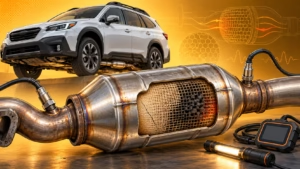
Mercedes W124, W202, W210, and W211 vehicles can have different engines, exhaust layouts, and part references within the same chassis generation. A chassis name narrows the search, but it does not identify the correct replacement or establish used value. Engine type, production details, original equipment status, and the unit’s markings all help separate one assembly from another. For orientation, the W124 was built from 1984 to 1997, the W202 C-Class from 1993 to 2000, the W210 E-Class from 1995 to 2002 and the W211 E-Class from 2002 to 2009, so many of these cars in Kazakhstan are now 15 to 40 years old.
For example, a search for a Mercedes 124 catalytic converter may bring up parts for several versions of the W124. The same caution applies to a Mercedes W202 catalytic converter. Do not treat a listing with the right chassis name as proof of fit. Ask the supplier to confirm the exact application, including any relevant production split.
A Mercedes W210 catalytic converter or Mercedes W211 catalytic converter also needs more than a model-name match. Depending on the vehicle, the exhaust can contain more than one catalyst section. Establish which section needs attention and whether the quote covers one unit or a larger assembly. That detail matters for both repair planning and comparison of removed parts.
Identification details to gather before requesting a quote
| Detail | What to provide | Why it helps |
|---|---|---|
| Vehicle identity | VIN, chassis generation, and production year | Helps the supplier check the application |
| Engine details | Engine code and fuel type | Separates versions with different exhaust needs |
| Part markings | Clear images of stamped references and logos | Supports part identification and assessment |
| Complete assembly | Photos of the housing, pipes, joints, and sensor points | Shows layout, condition, and completeness |
If the markings are hard to read, use good light and take several close photos rather than scraping the housing. Include a wider image so the assessor can see where each marking sits. Photos help with an initial review, but they do not prove the condition of the material inside.
What affects the value of a removed Mercedes unit?
A removed unit’s catalytic converter price depends on its exact identity, original equipment status, internal condition, completeness, and current market conditions. A Mercedes badge alone cannot establish value. Two units from cars of similar age may need separate assessments because their references, contents, and condition differ, even when their outer housings look much the same.
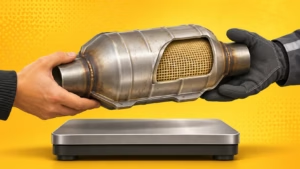
Original equipment status is useful information, not a promise of a high offer. An original housing may contain damaged or missing material, while an aftermarket replacement needs its own assessment. Keep the unit intact so the buyer can check what is present. Tell the buyer about impact damage, previous repairs, or any known engine fault that may have contaminated the internal material. At QazaqKat, readable markings are checked against an internal database of more than 30,000 converter models built with lab-tested chemical analysis, which is why a clear photo of the stamp saves time.
- Exact reference: Clear markings help identify the individual part.
- Completeness: Missing sections or internal material can affect the assessment.
- Damage: A crushed housing or broken core needs review.
- Contamination: Oil, coolant, and other deposits may affect condition.
- Assessment terms: An initial estimate may differ from a confirmed offer after inspection.
When requesting a catalytic converter price, send clear photographs and ask what the estimate assumes. Find out whether the buyer needs a physical inspection and what could change the final offer. Compare quotes for the same complete unit under similar terms, rather than comparing a firm offer with an unexplained online figure.
Should you repair the car, replace the unit, or sell it?
Repair the car when testing finds a fixable engine or exhaust fault, replace the unit when confirmed failure requires it, and assess resale only after removal is justified. These are separate decisions. The value of a removed part should not drive a repair diagnosis, and a low resale estimate does not prove that the part was fit to stay on the vehicle.
Ask for an itemised repair quote and clear warranty terms. For an older Mercedes, consider the wider condition of the engine and exhaust before committing to work. Qazaqkat’s guide to service life and wear factors provides background on why condition matters more than age alone. A replacement should address a confirmed need, not serve as a trial fix.
Once a workshop removes the old unit, let it cool and arrange safe handling. Do not cut it open, break the core, or try to recover material yourself. Ask the buyer which ownership or repair documents are required, and keep receipts where applicable. Choose repairers and buyers who explain their checks, quote terms, and handling process, and avoid unlawful exhaust removal or emissions-system changes.
Summary
A sound Mercedes repair starts with diagnosis, not a parts order. Confirm the fault, match the replacement to the exact vehicle, and compare the whole repair bill. Treat any removed catalytic converter as an individual part whose identity and condition need checking. For owners and trade partners in Kazakhstan, Qazaqkat offers catalytic converter purchasing and recycling support. Clear photos, readable markings, and honest condition details give a useful starting point for an assessment.
FAQ
Does a P0420 code mean I need a new exhaust catalyst?
No. A P0420 code points toward catalyst-system efficiency, but it does not establish the full cause. A technician should check related faults, sensor operation, exhaust leaks, and engine condition before recommending replacement. Ask for the test findings rather than accepting a parts order based only on the stored code.
Can I use the same part on two Mercedes cars with the same badge?
Not without a fitment check. Cars with the same badge can differ by engine, production date, and exhaust specification. Supply the VIN, engine code, and existing part reference when asking for a replacement. Written confirmation from the supplier is more useful than a listing that names only the model.
Is an original Mercedes unit always worth more when removed?
Original equipment status helps identify a unit, but it does not guarantee a higher offer. The exact reference, remaining internal material, damage, and contamination still matter. A buyer should assess the actual component. Neither the Mercedes name nor the age of the car provides a reliable valuation on its own.
Can I sell a unit with a damaged outer housing?
A damaged housing does not by itself settle whether a buyer will accept the unit or what the offer will be. Send photos of the whole assembly and close-ups of the damage. Keep the remaining material intact, describe what happened, and ask whether the buyer needs an inspection before confirming terms.
What should I prepare before contacting a recycling company?
Prepare clear photographs, readable part markings, vehicle details, and a short account of the unit’s condition. Ask which ownership documents the buyer requires and whether the first quote is provisional. Keep the assembly intact, and confirm inspection, delivery, and payment terms before arranging a handover or sending the part.